Probabilistic Neural Networks
β-NLL for heteroscedastic uncertainty estimation
In this project, we investigate learning probabilistic neural networks, that is, neural networks that output an uncertainty-aware prediction. Specifically, we are interested in modeling aleatoric uncertainty, which is the uncertainty inherent in the data. Recognizing such uncertainties is for example useful in model-based RL or for controlled exploration.
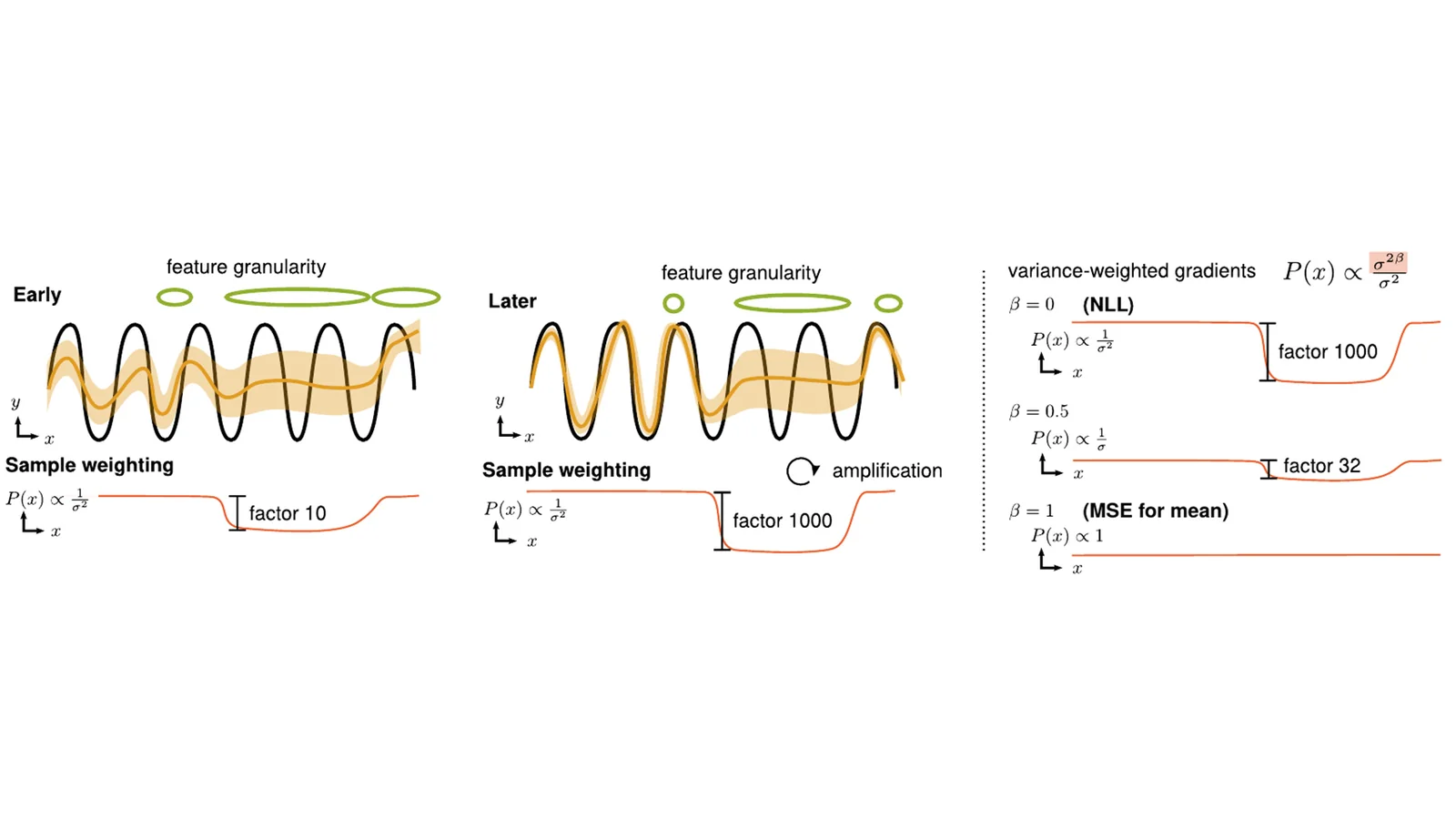
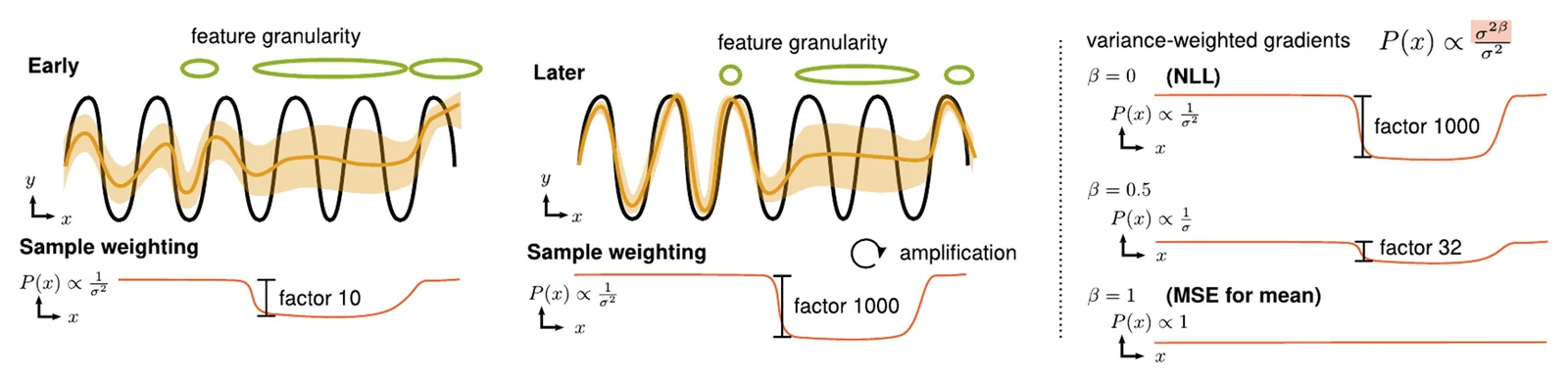
The standard approach to modeling (heteroscedastic) aleatoric uncertainty is to predict mean and variance of a Gaussian distribution, and train the model by minimizing the negative log likelihood (NLL) of the data. In practice, this approach encounters certain optimization difficulties which lead to suboptimal predictive accuracy. In this project, we investigated the reasons behind this phenomenon and found that it is related to unequally weighted gradients across the data. We identify a simple solution, which we call β-NLL, that simply reweights the gradients in the loss. We show that the new loss leads to higher accuracy, calibrated uncertainties, is robust to hyperparameters and simple to implement.
A PyTorch implementation of the loss function:
def beta_nll_loss(mean, variance, target, beta=0.5):
    """Compute beta-NLL loss

    :param mean: Predicted mean of shape B x D
    :param variance: Predicted variance of shape B x D
    :param target: Target of shape B x D
    :param beta: Parameter from range [0, 1] controlling relative
        weighting between data points, where `0` corresponds to
        high weight on low error points and `1` to an equal weighting.
    :returns: Loss per batch element of shape B
    """
    loss = 0.5 * ((target - mean) ** 2 / variance + variance.log())

    if beta > 0:
        loss = loss * (variance.detach() ** beta)

    return loss.sum(axis=-1)
Publications